
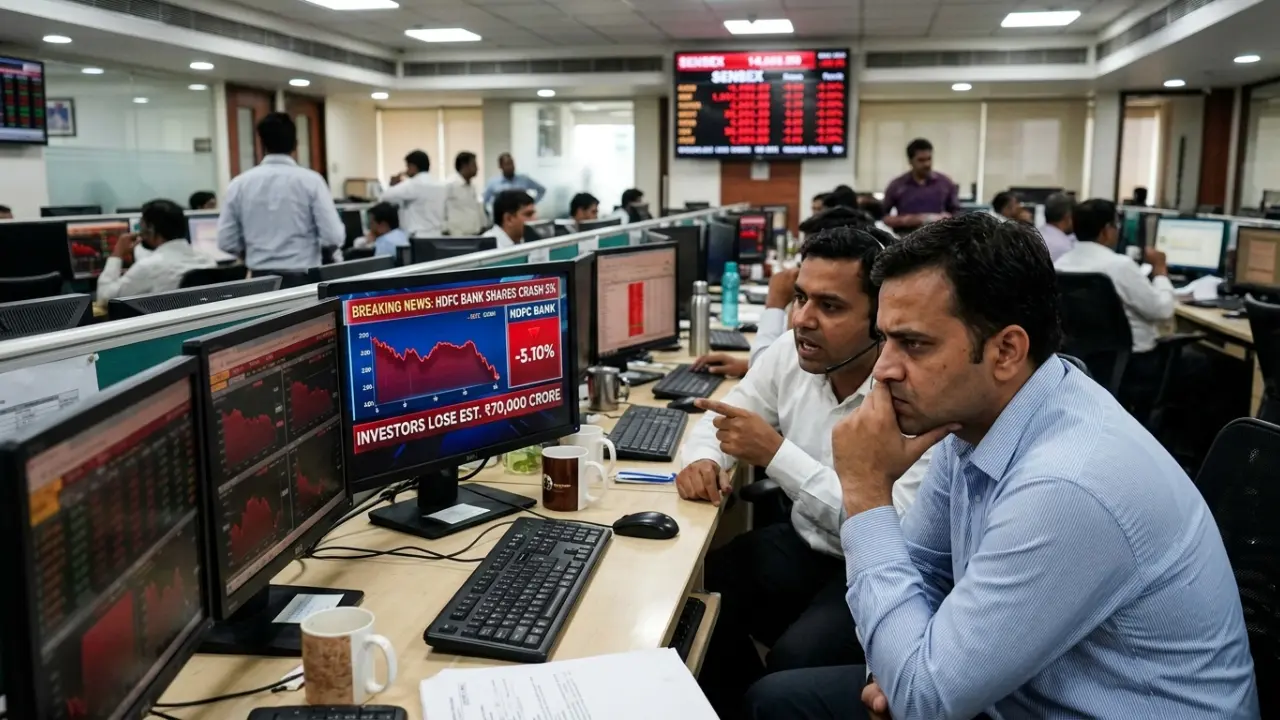
HDFC Bank shares came under heavy selling pressure on Monday, July 20, after the private sector lender’s June-quarter earnings failed to fully satisfy investors. The stock closed at around ₹777.60 on the NSE, down ₹42, or 5.12%, from its previous close of ₹819.60. During the trading session, the shares moved between ₹774.55 and ₹790.The sharp fall came as investors reacted to the bank’s first-quarter performance, with the results marginally missing market expectations on key parameters, including net interest income and profit. The reaction also affected the broader banking space, with the Nifty Bank index coming under pressure during the trading session.
HDFC Bank Shares Face Sharp Selling After Q1 Earnings
The immediate trigger behind Monday’s decline was the market’s reaction to HDFC Bank’s Q1 FY27 results. Although the bank continued to report growth in profit, investors focused on the fact that some important numbers were below expectations. In the stock market, even a large company with strong long-term fundamentals can see heavy selling when quarterly results fail to match what investors were expecting.HDFC Bank’s shares opened lower and remained under pressure throughout the session. The stock then closed near the bottom of the range, indicating strong selling pressure. It also led to a substantial decrease in the value of the bank as per reports, about ₹70000 crore was lost by investors in the share value.
Why Investors Are Concerned About the Latest Results
The market’s concern is not necessarily that HDFC Bank has suddenly become a weak company. Instead, investors are closely watching the bank’s growth momentum and key profitability indicators. Net interest income, which represents the difference between interest earned on loans and interest paid on deposits, is one of the most important figures for a bank.When this figure grows more slowly than expected, investors may become cautious about future earnings growth. Market participants are also watching the bank’s margins, loan growth and overall business performance as the financial sector continues to deal with changing interest-rate conditions and intense competition for deposits.The latest reaction shows that investors are currently demanding stronger performance from large private-sector banks. Even though HDFC Bank remains one of India’s biggest and most closely followed lenders, its quarterly numbers are being compared closely with those of other major banks.
HDFC Bank Stock Performance and 52-Week Range
After Monday’s decline, HDFC Bank shares remained well below their 52-week high of around ₹1,020.50. The stock’s 52-week low stood at approximately ₹726.65, meaning the current price is closer to the lower end of its yearly trading range.The stock has also faced pressure over the longer term. Market data showed that HDFC Bank shares were down nearly 12% over the previous six months and around 17.5% year-on-year. The fall has made the stock a major focus for investors tracking large-cap banking companies and the Nifty Bank index.
What Investors Will Watch Next
Following the sharp drop, investors are likely to be focussed on whether HDFC Bank can report higher growth in the coming quarters. Loan growth, deposit mobilisation, net interest margins and asset quality will remain important factors for the stock market.Some brokerages have continued to maintain positive views on the stock despite the immediate fall, suggesting that the recent weakness may be linked more to quarterly expectations than to a major change in the bank’s long-term business outlook. However, investors will still closely monitor upcoming financial results before taking a fresh view on the stock.For now, HDFC Bank shares remain under pressure after the Q1 earnings reaction. The stock’s next move will probably depend on how investors interpret the bank’s earnings growth, margins, and prospects. The big drop is a reminder that even blue-chip stocks can be extremely volatile securities if disappointments occur during key periods.