
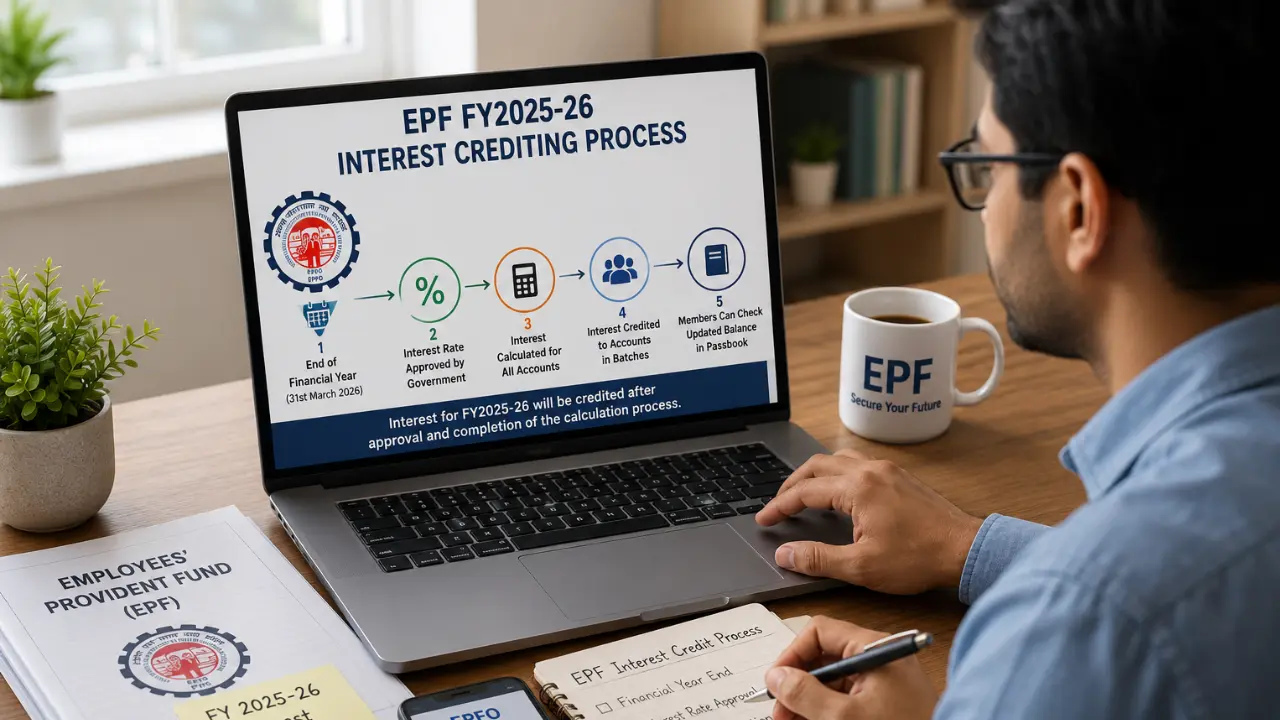
Millions of workers in India look forward every year to the one critical announcement that the Employees’ Provident Fund Organisation (EPFO) makes regarding the crediting of interest on their Employees’ Provident Fund (EPF) account. The process of crediting of interest on accounts for the fiscal year 2025-26 has a process which involves several steps that happen after the end of the fiscal year. Although interest begins from the start of the fiscal year, it appears in the members’ accounts once the process by EPFO is completed.
The EPF is one of the biggest pension funds in India which aims at providing its members financial stability in their future lives. Both workers and employers pay into the fund monthly. Moreover, EPFO pays annual interest on the total savings. The interest is an important factor which helps in growing savings.
The credit of interest for the fiscal year 2025-26 starts after the closure of the financial year on March 31, 2026. Before the credit of interest is done in the members’ accounts, the EPFO completes the process of preparing the financial statements and makes the calculation of interest based on the approved annual interest rate. The rate is proposed by the Central Board of Trustees, which needs to get the approval of the Government of India. After the approval of the Government of India, the EPFO begins the process of making interest calculations for all eligible member accounts. The EPFO has digitalized systems for making interest calculations for the eligible accounts using the running balance of each month during the fiscal year. As EPFO has many accounts, it becomes a lengthy process.
Subscribers will find that there is no uniformity when it comes to the visibility of the interest. This is expected since the process of crediting happens in batches. It does not matter whether the interest credits later because there is no loss of eligible interest at all as it is credited for the financial year.The subscribers during the crediting period frequently review their EPF passbooks in order to check whether the interest is credited. They can see the updated balance after the process of processing of the account is done. The access to the EPF passbook can be provided by the help of the EPFO portal or the UMANG mobile app by means of Universal Account Number (UAN).It should be noted that the process of visible crediting of the interest does not change anything regarding the actual earned interest. EPFO calculates the interest according to the approved interest rate and the account balance of the financial year. Thus, there is no danger if the interest is credited weeks or months later because the eligible interest is still protected by the approved calculation.
Those employees who have switched jobs recently also need to verify whether their EPF accounts have been transferred properly and whether their UAN has been made active by providing all the required KYC details. Updated documents can assist in managing your account effectively and also help you access your money without any hindrance. Any sort of discrepancy in account details can be sorted out by using EPFO’s grievance mechanism or even contacting your employer.
The members should avoid falling prey to the rumors floating around in the social media about the interest credits. Each year, several rumors can be found on the internet saying that the interest credits have already happened when actually the process is still going on. The best way to find out is through the official EPF passbook or EPFO’s announcements.
Interest crediting of the EPF in the fiscal year 2025-26 will be an annual process conducted by the organization in order to ensure that all eligible subscribers receive the interest credited in their provident fund account after receiving the necessary approvals for the same. Even though the process can take some time due to the number of accounts to calculate, the interest is credited to all accounts in accordance with the approved interest rate. Interest received annually is a crucial part of retirement savings for millions of salaried workers.
1 thought on “EPF FY2025-26 Interest Credit: Here’s How It Works ”